Let's Cycle
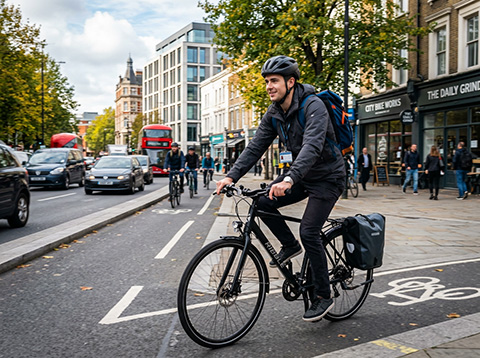 Commuting to work by bicycle offers numerous financial, physical, and environmental benefits. Compared with driving an automobile, a bicycle requires very little maintenance, no fuel, minimal insurance costs, and inexpensive replacement parts, making it one of the least costly forms of transportation available. At the same time, the daily ride provides regular aerobic exercise that can improve cardiovascular health, help maintain a healthy weight, reduce stress, and increase energy levels without requiring extra time set aside for a workout. Cycling also produces no tailpipe emissions, reduces traffic congestion, and requires far less parking space than a motor vehicle. For people who live within a few miles of their workplace, commuting by bicycle can be an economical, healthy, and enjoyable way to travel while turning an otherwise routine commute into an opportunity to improve overall well-being.
For most people, there is a practical commuting distance that allows them to arrive at work without needing a shower, although it depends on fitness, weather, terrain, and how hard they ride.
As a general guideline:
1–3 miles (2–5 km): Most people can ride this distance at an easy pace with little or no sweating, especially on level ground.
3–5 miles (5–8 km): Often manageable without a shower if you ride leisurely (8–10 mph), avoid hills, and the weather is cool.
5–10 miles (8–16 km): Many regular cyclists can do this without needing a shower, but it usually requires a relaxed pace, breathable clothing, and favorable weather.
Over 10 miles (16 km): A shower becomes more likely, particularly in warm weather or on hilly routes.
Several factors make a big difference:
Temperature and humidity: Cool, dry weather greatly reduces sweating.
Terrain: Flat routes are much easier than steep hills.
Pace: Riding at 8–10 mph instead of 15–18 mph can dramatically reduce perspiration.
Bicycle type: An electric bicycle (especially with pedal assist) lets many people commute 10–20 miles while staying much cooler.
Clothing: Moisture-wicking clothing and changing into work clothes after arriving can eliminate the need for a shower.
For many commuters, 5 miles each way is a realistic distance to ride comfortably without showering if the route is fairly flat and they ride at an easy pace. If you use a pedal-assist e-bike, that comfortable range often extends to 10–15 miles.
Cost savings
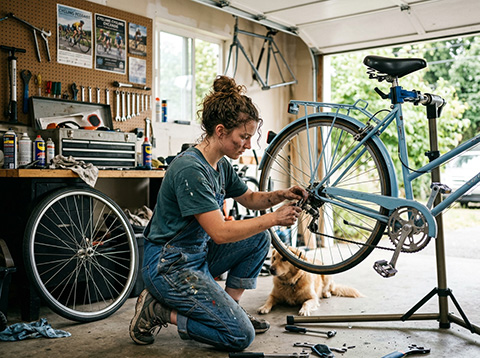 Assuming a 5-mile trip to work and 5 miles home, 5 days per week, and 50 working weeks per year, the commute totals:
10 miles per day
50 miles per week
2,500 miles per year
A reasonable comparison is:
Expense Bicycle Average Automobile
Purchase/depreciation $100–300 $2,500–4,000
Maintenance &mp repairs $100–250 $1,000–1,500
Fuel or electricity $0–50 (extra food calories are minimal) $300–500
Insurance $0–100 $1,200–2,000
Registration &mp taxes $0 $150–400
Tires &mp consumables $50–100 $200–400
Approximate annual total $250–800 $5,500–8,800
If the automobile is owned only for this commute, the bicycle can reduce transportation costs by about $5,000–8,000 per year. Even if the car is kept for other purposes, replacing a 2,500-mile annual commute with bicycle travel can still save several hundred dollars each year in fuel, maintenance, tire wear, and depreciation.
In addition to the financial savings, cycling provides regular physical activity. A 10-mile round-trip commute typically burns 300–600 calories per day, which can improve cardiovascular fitness, reduce healthcare costs over time, and lessen dependence on structured exercise. For people living within about 5 miles of work, commuting by bicycle can be one of the most economical forms of transportation available while also providing meaningful health benefits.